Forward Deployed Engineer: Role, Responsibilities & Use Cases
Most software projects fail not because of bad code, but because of the gap between how the product was designed and how it actually runs inside a client's environment. The forward-deployed engineer exists to close that gap. Not by writing documentation or running demos, but by embedding directly with the client, building production-grade solutions in place, and staying until they work.
It is one of the most demanding roles in engineering. It is also one of the fastest-growing, driven largely by the explosion in enterprise AI adoption and the reality that deploying AI in production is nothing like deploying it in a sandbox.
What Is a Forward Deployed Engineer?
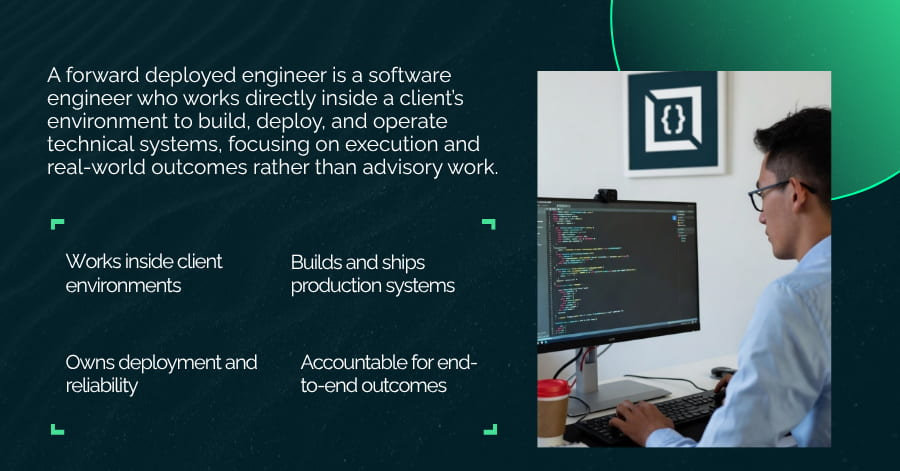
A forward deployed engineer is a software engineer who works directly inside a client's environment to build, deploy, and operate technical solutions. The job is not advisory. The FDE writes production code, owns delivery end-to-end, and is accountable for outcomes in a way that a consultant or solutions architect is not.
The term originated at Palantir, which pioneered the model in the early 2010s by embedding engineers at military sites and government agencies. Until 2016, Palantir had more FDEs than software engineers. That ratio tells you how central the role was to their entire business model.
The approach proved effective enough that companies like OpenAI, Anthropic, Databricks, and Cohere have since built their own forward deployed engineering teams, and the model has spread across enterprise SaaS broadly.
Why the FDE Role Exists
Software is designed for a hypothetical environment. The real environment is messier: legacy systems that were never designed to integrate with anything modern, authentication setups that predate OAuth, data residency requirements that nobody flagged in the sales cycle, and internal stakeholders who have different definitions of what "done" means.
Traditional engineering roles sit too far from this reality to solve it effectively. Core product engineers build for the general case. Solutions architects design on whiteboards. Account managers escalate tickets. None of them are in the room when the integration breaks at 2am the day before go-live.
The FDE is in that room. The role exists because complex software needs someone with the technical depth to build and fix things on the spot, combined with the client proximity to understand what actually needs to be built.
How FDEs Differ From Similar Roles
The easiest way to misunderstand an FDE is to conflate it with the roles it resembles, the differences are real and matter for both hiring and organizational design.
Role | Primary focus | Do they write production code? | Who do they own outcomes for? |
Forward Deployed Engineer | Build and deploy in the client environment | Yes | Client outcomes, end-to-end |
Solutions / Sales Engineer | Pre-sale technical validation and demo | Rarely | The deal |
Customer Success Engineer | Post-sale adoption within existing product capabilities | Sometimes | Retention and usage |
Implementation Consultant | Process design, configuration, documentation | No | Recommendations |
FDE vs. Solutions / Sales Engineer
A solutions engineer's job is to establish what is possible before a contract is signed. They run technical evaluations, answer integration questions, and build confidence that the product can do what the client needs. Once the deal closes, their job is largely done. The FDE picks up where the solutions engineer left off and does the actual building.
FDE vs. Customer Success Engineer
Customer success engineers help clients get value from the product as it exists. They troubleshoot, configure, and train. They work within the product's current capabilities. An FDE extends those capabilities when the existing product does not fit the client's environment. The distinction is whether the engineer is operating within the product boundary or expanding it.
FDE vs. Implementation Consultant
Consultants design solutions and hand off recommendations. An FDE owns the outcome, which means writing the code, running the deployment, and staying engaged until the system is in production and working. The accountability is different. A consultant can walk away from a failed implementation. An FDE cannot.
Core Responsibilities
The FDE role spans two domains that most engineering roles keep separate: deep technical execution and client-facing communication. Both matter, and the inability to do either well is a reason the role is hard to fill.
Technical Responsibilities
The hands-on work varies by engagement, but the core remains consistent: building solutions that function in the client’s real environment rather than a controlled setup.
This includes developing custom integrations with internal APIs, creating data pipelines that handle complex and imperfect enterprise data, deploying and configuring AI workflows on existing infrastructure, troubleshooting production issues with limited tooling, and taking full ownership of the technical architecture end-to-end.
Client-Facing Responsibilities
The FDE is also the technical face of the product inside the client's organization. This means translating vague business requirements into buildable technical plans, running working sessions with stakeholders at every level from individual contributors to C-suite, setting expectations about what is technically feasible in the available time, and communicating clearly when something is not going to work the way the client expected.
The client-facing work is not incidental to the role. An FDE who cannot communicate clearly will have trouble getting the access, context, and organizational buy-in needed to build anything.
Key Skills and Profile
The FDE role does not have a clean skills profile because it requires two types of ability that rarely appear together. Strong engineers who struggle with ambiguity and stakeholder communication will not thrive. Strong communicators without genuine coding depth will be found out quickly when the client's system breaks and someone needs to fix it.
Technical Skills
The technical baseline is high. FDEs need to be fluent in at least one systems language (Python and TypeScript are the most common) and one query language (SQL in most enterprise contexts). Beyond coding, the role requires working knowledge of cloud infrastructure (AWS, GCP, or Azure), API design and integration patterns, data pipeline architecture, and increasingly, LLM deployment and agentic workflow design.
Analysis of over 1,000 FDE job postings from 2025 found LLM experience mentioned in 31% of listings, RAG architecture in 12%, and orchestration frameworks like LangChain in 4%. The technical requirements have shifted fast toward AI deployment skills.
The profile is T-shaped: broad enough to work across the full stack, deep enough to build production-grade systems without support. A generalist who cannot write reliable code under pressure will not last.
Soft Skills and Business Acumen
The non-technical requirements are equally specific. FDEs need to decompose vague, ambiguous business problems into concrete engineering tasks. They need to navigate organizational politics without getting stuck in them.
They need to build trust quickly with people who are skeptical that an outside engineer can actually solve their problem. And they need to know when to push back on a request that is technically feasible but wrong for the client's situation.
The ability to translate between business language and engineering language is the core soft skill. An FDE who cannot do this will either build the wrong thing or spend the engagement managing misaligned expectations.
The FDE Model in Practice
How FDE engagements are structured varies by company and client, but most fall into one of two working models.
Solo Embedding vs. Pod-Based Teams
In the solo model, a single FDE is embedded with a client for a defined period. This works well for smaller clients, focused problem statements, and engagements where the scope is clear enough that one engineer can own it. The FDE has high autonomy and direct client relationships, but no backup when something outside their expertise comes up.
In the pod model, two to four FDEs work as a unit, often with complementary skills: one with deeper data infrastructure experience, one with frontend or integration expertise. Palantir and Ramp both use pod-based structures for larger engagements. The coordination overhead is higher, but the pod can handle broader scope and provides internal review capacity that a solo FDE does not have.
From Field to Product: The Feedback Loop
One of the underrated aspects of the FDE model is what comes back to the core product team. An FDE embedded with ten clients across a year will encounter the same edge cases, the same integration problems, and the same missing capabilities repeatedly. That pattern of real-world friction is more useful product signal than any user survey.
Companies that run FDE programs well treat this feedback loop as a strategic asset. The FDE is not just solving the client's problem. They are generating the data the product team needs to eliminate the category of problem entirely.
Why FDE Demand Is Surging
The growth in FDE job postings is not a coincidence. It comes from how AI adoption is unfolding. Companies that adopted AI platforms in 2023 and 2024 are now trying to operationalize them inside existing stacks that were never designed for AI. This creates an "integration wall" where promising demos collide with real authentication systems, messy data, and strict compliance requirements, often causing deployments to stall. FDEs play a key role in overcoming this barrier.
Companies like OpenAI, Anthropic, Databricks, and Cohere have expanded their FDE programs in response. The model is spreading because it addresses a universal challenge in enterprise software: bridging the gap between what AI products can do and what real-world environments allow.
Industry Use Cases
Across industries, the role looks different on the surface, but the core problem stays the same: taking a capable AI product and making it function reliably inside real systems where data, integrations, and constraints rarely align cleanly.
Financial Services
In fintech and banking, FDEs work inside environments where regulatory constraints, data residency requirements, and security protocols govern almost every technical decision. The product might handle fraud detection, payment orchestration, or compliance monitoring.
The FDE's job is to make it work against real transaction data, inside the client's infrastructure, under their compliance rules. Product gaps in these environments are not inconveniences. They are revenue-blocking or audit risks.
Healthcare and Government
Healthcare and government deployments involve the highest-stakes versions of the same core challenge: sensitive data, strict regulatory frameworks, and infrastructure that was not designed for modern integration patterns.
An FDE in these environments needs to understand HIPAA constraints or FedRAMP requirements well enough to make architectural decisions that satisfy both the technical requirements and the compliance team. Most of the work is navigating these constraints without letting them become a reason nothing gets built.
SaaS and AI Platforms
This is the most common context for FDE work. A client has purchased an AI platform and needs someone to make it work with their CRM, their internal APIs, their data warehouse, and their existing authentication setup.
The product works in demos. It needs to work in production. The FDE bridges that gap, building the integrations, configuring the workflows, and staying embedded until the system runs reliably without daily intervention.
Career Path and Growth
FDEs typically enter the role from one of three backgrounds: software engineering, solutions engineering, or technical consulting. The common thread is a combination of real coding ability and some experience working directly with external stakeholders.
Progression follows a path that mirrors standard engineering seniority: FDE to Senior FDE to Principal FDE, with lateral moves into Technical Solutions Architect or VP of Solutions Engineering at the top. The timeline can compress significantly for high performers. FDEs who consistently deliver strong client outcomes have direct visibility into business impact that most engineering roles do not, and that visibility tends to accelerate promotion cycles.
How to Know If the FDE Path Is Right for You
The profile of someone who thrives in the role is specific. They are comfortable with ambiguity because client environments are always messier than expected. They can build quickly without the support structure of a large engineering team behind them. They find client relationships energizing rather than draining. They are capable of making good architectural decisions under time pressure and with incomplete information.
The profile of someone who finds the role unsatisfying is equally specific: engineers who prefer deep, focused work on a single well-defined problem, who find context switching across multiple client domains costly, or who prefer to minimize time spent communicating with non-technical stakeholders. The role involves a lot of travel for most FDE positions (30 to 60% on-site at client locations is common), which is a practical constraint that matters.
Where FDEs Go Next
The FDE role is genuinely a career accelerator. The combination of engineering depth, client relationship experience, and direct exposure to business problems makes it an unusually good foundation for moves into product management, engineering leadership, or founding a company.
Many FDEs who identified a recurring client problem during their engagements have gone on to build startups solving exactly that problem. The field experience is hard to replicate any other way.
Is the FDE Model Right for Your Organization?
The FDE model is the right choice when three conditions are true: the product is technically complex enough that clients cannot operationalize it independently, client environments vary significantly enough that a one-size-fits-all implementation approach will not work, and the cost of a failed or delayed deployment is high enough to justify the investment in dedicated embedded engineering.
It is not the right model for products where implementation is standardized and low-touch, where client environments are predictable, or where the business model depends on high volume and thin margins per client. FDE programs are expensive. The compensation is substantially higher than comparable engineering roles, travel and engagement overhead adds cost, and the model does not scale the same way a self-serve product motion does.
The right question is not whether FDEs are valuable in the abstract. It is whether your product complexity and client environment variability create a real integration wall that is costing you deals, delaying deployments, or driving churn.
Final Thoughts
The forward deployed engineer exists because the distance between a working product and a working deployment inside a real enterprise environment is larger than most software companies account for. The role closes that distance with engineering rather than documentation, and with ownership rather than advice.
As enterprise AI adoption continues to accelerate in 2026 and beyond, the integration wall is not going away. It is getting higher. The companies building FDE programs now are building the capability to close deals and retain clients that their competitors without this capability will struggle to serve.
If you are evaluating whether to build FDE capacity into your team or wondering how to structure technical delivery for complex enterprise clients, connect with us to discuss how to design an engagement model that fits your product, your clients, and your growth stage.
Frequently Asked Questions
What exactly does a forward deployed engineer do?
A forward deployed engineer embeds directly with a client to build, deploy, and operate technical solutions inside that client's environment. Unlike a consultant, the FDE writes production code and owns the outcome. Unlike a solutions engineer, the FDE is engaged post-sale and focused on delivery rather than evaluation.
How is an FDE different from a solutions engineer?
A solutions engineer works pre-sale to validate technical fit and build confidence that the product can meet the client's needs. An FDE picks up after the deal closes and does the actual building. The roles are complementary but distinct. Conflating them usually means either the SE is being asked to build things they were not hired to build, or the FDE is being used as a pre-sales resource before they have the context to be effective.
What technical skills does an FDE need?
The baseline is strong coding ability in Python or TypeScript, working knowledge of SQL and data systems, and familiarity with cloud infrastructure. For AI-focused FDE roles, experience deploying LLMs and building agentic workflows has become a core requirement. The profile is T-shaped: broad enough to own a full-stack deployment independently, deep enough to debug production failures without external support.
What does an FDE earn?
Compensation varies significantly by company and level. At AI labs like OpenAI and Anthropic, total compensation for mid-to-senior FDEs typically runs between $350K and $550K. At Palantir, average total compensation is around $238K. Across the broader market, median FDE salaries based on disclosed job postings were around $174K in 2025. FDEs are compensated as engineers, not salespeople, and these roles do not carry quotas or commission structures.
How do you hire a good FDE?
The two failure modes to screen for are strong communicators who cannot actually code, and strong engineers who cannot function effectively in client-facing environments. The evaluation needs to test both dimensions directly. A technical exercise that mirrors real deployment constraints screens for the first. Reference checks focused specifically on client-facing work, and a structured interview that puts the candidate in an ambiguous, stakeholder-heavy scenario, screen for the second.