Hire Nearshore .NET Developer
.NET remains one of the most widely used enterprise stacks, and senior .NET engineers in the US are consistently difficult to hire. Roles stay open for months, compensation keeps climbing, and the timeline from job posting to productive team member stretches past six months in most cases.
Latin America has become the primary nearshore destination for US companies hiring .NET talent because it solves the three problems that make domestic hiring slow: cost, availability, and time zone alignment.
Let’s see how nearshore .NET hiring works, what to look for in candidates and partners, how engagement models differ, and what the actual costs look like.
What is a Nearshore .NET Developer?
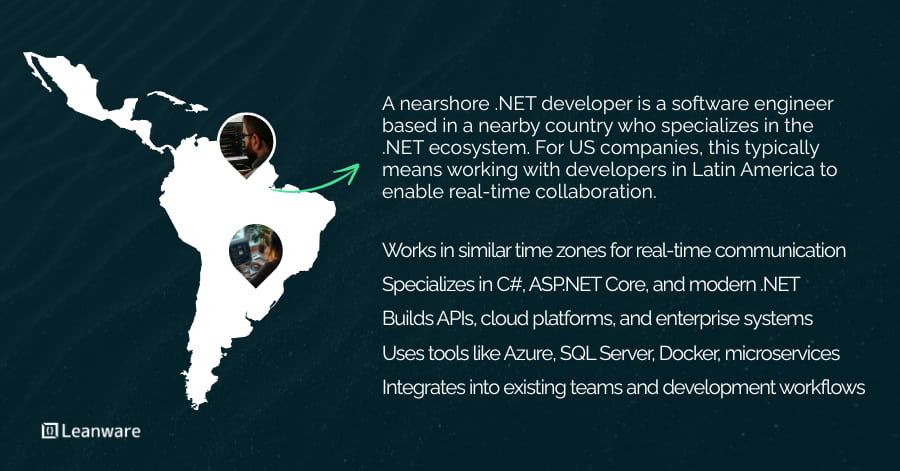
A nearshore .NET developer is a software engineer specializing in Microsoft's .NET ecosystem who works remotely from a nearby country, typically in a similar or overlapping time zone. For US companies, this usually means Latin America: Colombia, Mexico, Argentina, Brazil, or Chile.
The "nearshore" distinction matters because it separates this model from offshore outsourcing (teams in distant time zones like India or Southeast Asia) and onshore hiring (US-based engineers). Nearshore combines the cost efficiency of offshore with the real-time collaboration advantages of onshore.
These developers work across the modern .NET stack: C#, ASP.NET Core, .NET 8, Entity Framework, SQL Server, Azure, REST APIs, Docker, and microservices architectures. They build and maintain the same enterprise-grade systems that US-based .NET engineers do.
Why Companies Hire Nearshore .NET Developers
The reasons are the same across companies that have adopted this model.
Talent availability: .NET engineers are in high demand in the US, and senior-level roles take months to fill. LATAM has a growing pool of experienced .NET developers with enterprise backgrounds and cloud infrastructure experience.
Cost efficiency: Hiring a senior .NET developer nearshore saves 40 to 60% compared to US rates, even after accounting for the engagement model and management overhead. For a five-person engineering team, that difference can exceed $400,000 annually.
Time zone alignment: LATAM engineers typically work within one to two hours of US Eastern and Central time. This means shared working hours for standups, code reviews, pair programming, and real-time communication, which offshore models in distant time zones cannot match.
Faster hiring: Through a nearshore partner, a qualified .NET developer can be onboarded in two to four weeks. US hiring for the same role takes three to six months on average when you account for sourcing, interviewing, and notice periods.
Cultural compatibility: LATAM engineering teams are accustomed to agile workflows, distributed collaboration, and US communication norms. The adjustment period for integrating a nearshore developer into an existing team is typically measured in days, not months.
Find Nearshore .NET Developer
Companies looking for nearshore .NET engineers have several sourcing options, each with different levels of vetting and support.
Nearshore development partners like Leanware handle the full process: sourcing, screening, technical vetting, and onboarding. The partner maintains the employment relationship and ensures quality, retention, and operational continuity. This is the most common model for companies that want pre-vetted, senior-level talent without managing the hiring process directly.
Specialized tech recruitment agencies focus on matching individual candidates to open roles. The company manages the interview and hiring process but gets access to a curated candidate pool. This works well when the company has internal capacity to evaluate and onboard candidates.
Developer marketplaces like Turing, Toptal, or Arc provide access to individual contractors. The vetting depth varies by platform. This model offers flexibility for short-term needs but requires more internal management.
Direct hiring through job boards in LATAM markets is possible but requires understanding local employment law, compensation benchmarks, and benefits structures. Most companies without a legal entity in the target country work through an Employer of Record (EOR) or a nearshore partner instead.
Benefits of Hiring Nearshore .NET Developers
The benefits extend beyond cost savings into operational efficiency and team scalability.
Nearshore developers operate during your working hours, which eliminates the async communication delays that slow down offshore engagements. Code reviews happen in real time. Blockers get resolved within hours instead of waiting for the next business day in a different hemisphere.
The engagement scales in both directions. You can add developers when the roadmap demands it and reduce capacity when a milestone is reached. This flexibility is difficult to achieve with full-time US hires, where scaling down involves layoffs or redeployment.
Integration with existing teams is straightforward when the nearshore developer joins your tools, attends your standups, and participates in your sprint ceremonies. The best nearshore engagements are indistinguishable from having a remote US team member.
Key Skills to Look for in a Nearshore .NET Developer
When evaluating candidates, focus on both technical depth and the ability to work effectively in a distributed team.
Technical skills:
- Strong proficiency in C# and ASP.NET Core
- Experience building and consuming REST APIs
- Cloud infrastructure experience with Azure or AWS
- Database management with SQL Server, PostgreSQL, or both
- Familiarity with microservices architecture and containerization (Docker, Kubernetes)
- CI/CD pipeline experience (Azure DevOps, GitHub Actions, Jenkins)
- Understanding of design patterns and clean architecture
Collaboration skills:
- Clear English communication (written and verbal)
- Experience working in agile/scrum environments
- Comfort with distributed team workflows and async communication tools
- Proactive communication about blockers, progress, and technical decisions
Technologies Used by Modern .NET Developers
The .NET ecosystem has evolved well beyond its Windows-only origins. Modern .NET developers work across a stack that supports cross-platform, cloud-native, enterprise-grade applications.
Technology | Role |
C# | Primary programming language |
ASP.NET Core | Web framework for APIs and web applications |
.NET 8 / .NET 9 | Current runtime versions |
Entity Framework Core | ORM for database access |
SQL Server / PostgreSQL | Relational databases |
Azure / AWS | Cloud infrastructure and managed services |
Docker | Containerization |
Kubernetes | Container orchestration |
Blazor | Web UI framework (server-side and WebAssembly) |
Azure DevOps / GitHub Actions | CI/CD pipelines |
gRPC | High-performance service communication |
SignalR | Real-time communication |
How to Hire a Nearshore .NET Developer
The hiring process follows a structured sequence regardless of whether you work through a partner or hire directly.
Define the Scope of Your Project
Determine whether you need a single developer to extend an existing team, a staff augmentation engagement for multiple engineers, or a dedicated team that owns a product area. The scope defines the hiring model, the seniority level required, and the engagement structure.
Evaluate Technical Expertise
Run a technical assessment that goes beyond coding tests. Review architecture decisions the candidate has made on previous projects. Discuss how they approach database design, API versioning, error handling, and deployment strategies.
Ask them to walk through a system they built and explain the decisions behind it. Candidates who can articulate their reasoning demonstrate deeper competence than those who can only write code to spec.
Assess Communication and Collaboration
Schedule a live conversation (not just written exchanges) to evaluate English fluency, communication clarity, and how the candidate handles ambiguity.
Ask about their experience working with distributed teams, how they handle time zone differences, and how they communicate blockers. For nearshore engagements, communication skills carry as much weight as technical skills.
Hiring Models for Nearshore .NET Developers
Three common engagement models cover most nearshore hiring scenarios.
Staff Augmentation
Individual developers join your existing team and work under your management. They attend your standups, follow your processes, and contribute to your codebase alongside your internal engineers.
This model works best when you have established workflows and need to increase capacity without changing how your team operates.
Dedicated Development Teams
A full team (developers, QA, tech lead) works exclusively on your product. The team operates with internal leadership and reports to your product or engineering manager.
This model fits when you need sustained capacity for a product area and want the team to build institutional knowledge over time.
Project-Based Development
A nearshore partner takes ownership of delivering a defined scope of work, from requirements through deployment. This model works for specific initiatives like building an MVP, migrating a legacy system, or developing a new module with clear boundaries.
Cost of Hiring a Nearshore .NET Developer
Costs vary by country, seniority, and engagement model.
Seniority | LATAM Hourly Rate | US Hourly Rate (Contractor/Agency) |
Junior | $25-$40/hr | $60-$90/hr |
Mid-Level | $40-$60/hr | $90-$130/hr |
Senior | $60-$80/hr | $130-$180/hr |
Tech Lead / Architect | $75-$100/hr | $150-$200+/hr |
These rates reflect contractor or agency engagement. Direct employment through an EOR adds statutory costs (social security, mandatory bonuses, severance) that typically run 25 to 40% above gross salary in LATAM countries. Even with those additions, total employer cost remains 60 to 65% below US equivalents.
Nearshore vs Offshore vs Onshore Development
Nearshore delivers cost efficiency alongside strong collaboration, with solid time zone overlap and cultural alignment. Offshore is cheaper but comes with coordination challenges, while onshore provides the best alignment at the highest cost.
Factor | Nearshore (LATAM) | Offshore (India, SE Asia) | Onshore (US) |
Hourly Rate (Senior) | $60-$80 | $25-$50 | $130-$180 |
Time Zone Overlap | Full or near-full | Minimal (8-12 hour gap) | Full |
Real-Time Collaboration | Yes | Limited | Yes |
Communication (English) | Strong in major hubs | Varies | Native |
Cultural Alignment (US) | High | Moderate | Full |
Hiring Speed | 2-4 weeks | 2-4 weeks | 3-6 months |
Total Cost of Ownership | Lower | Lowest hourly, higher hidden costs | Highest |
When Hiring Nearshore .NET Developers Makes the Most Sense
Nearshore .NET hiring fits specific situations where the combination of cost, speed, and collaboration quality matters.
Scaling an existing .NET team. When your product roadmap is growing faster than your internal hiring can keep up with, nearshore developers extend your capacity within weeks instead of months.
Building or modernizing enterprise applications. .NET is a dominant enterprise stack, and LATAM has a strong pool of engineers with experience in legacy modernization, cloud migration, and microservices architecture on .NET.
Developing an MVP. Startups validating a product concept can build on .NET with a nearshore team at a fraction of the cost of assembling a US-based engineering team.
Cloud migration to Azure. Companies moving from on-premise .NET applications to Azure cloud infrastructure can staff the migration with nearshore engineers who have direct Azure experience.
Extending internal teams for a specific initiative. When a project requires temporary capacity that does not justify a permanent hire, staff augmentation with a nearshore developer fills the gap.
Challenges of Nearshore Development and How to Avoid Them
Nearshore development works well when it is set up correctly. The common failure modes are avoidable.
Onboarding gaps: Without structured onboarding, new developers take longer to become productive. Provide documentation for your codebase, architecture, and development workflows. Assign a team member as a point of contact for the first two weeks.
Communication misalignment: Even with overlapping time zones, distributed teams need explicit communication norms. Define which decisions happen synchronously (standups, architecture discussions) and which can happen asynchronously (code reviews, documentation updates).
Quality control: Code quality varies across individual developers regardless of geography. Enforce code reviews, automated testing, and CI/CD pipelines for every engineer on the team. These practices matter more than where the developer is located.
Vendor quality: The nearshore market includes providers at every quality level. Evaluate partners based on their engineering standards, retention rates, and references from companies with similar technical requirements.
Why Companies Choose Nearshore Development in Latin America
LATAM has become the primary nearshore destination for US companies for converging reasons.
- The engineering talent pool is large and growing. Brazil has a significant number of software developers, while Colombia, Mexico, and Argentina each have mature tech ecosystems with strong university programs and active developer communities.
- Time zone alignment is a key advantage. Engineers in Colombia, Mexico, and Argentina work during US business hours without schedule adjustments. This enables the real-time collaboration that distributed software development requires.
- Cultural compatibility reduces onboarding time. LATAM engineers are accustomed to US business communication norms, agile workflows, and the tools US teams use (Slack, Jira, GitHub, Azure DevOps). The working relationship feels closer to hiring a remote US engineer than managing an offshore team.
- Cost savings are substantial and sustainable. Even with 8 to 12% annual salary growth in LATAM's tech market, nearshore rates remain 40 to 60% below US equivalents for comparable experience.
Hire Nearshore .NET Developers with Leanware
Leanware provides nearshore .NET engineers from Latin America for US companies that need to scale engineering capacity without the timeline or cost of domestic hiring.
Our engineers work across the modern .NET stack, including C#, ASP.NET Core, Azure, microservices, and containerized architectures. Every developer goes through technical vetting that evaluates architecture thinking, code quality, and the ability to work effectively in distributed teams.
We support staff augmentation, dedicated teams, and project-based engagements depending on what fits your product stage and team structure. Our developers integrate into your existing workflows, tools, and sprint ceremonies from day one.
If you are looking to hire nearshore .NET developers, connect with our team to discuss your requirements and see how we can match you with the right engineers for your stack and product goals.
Frequently Asked Questions
What is a nearshore .NET developer?
A nearshore .NET developer is a software engineer who specializes in Microsoft's .NET ecosystem and works remotely from a nearby country, typically in the same or a similar time zone. Many US companies hire nearshore developers from Latin America to build web applications, APIs, enterprise systems, and cloud platforms using C#, ASP.NET Core, and Azure.
Why do companies hire nearshore .NET developers?
Companies hire nearshore .NET developers to access skilled engineering talent while reducing costs and maintaining real-time collaboration. Nearshore teams usually share similar time zones, making communication easier than offshore outsourcing while offering significant cost savings compared to hiring locally.
What technologies do .NET developers typically use?
Modern .NET developers commonly work with C#, ASP.NET Core, .NET 8, Entity Framework, SQL Server, Azure Cloud, REST APIs, Docker, and microservices architectures. These technologies are widely used to build scalable enterprise applications and SaaS platforms.
How much does it cost to hire a nearshore .NET developer?
Senior .NET developers in Latin America typically cost between $60 and $80 per hour through a nearshore partner. This is significantly lower than the $130 to $180 per hour often required for senior developers in the United States.
What is the difference between nearshore and offshore development?
Nearshore development refers to hiring developers in nearby countries with similar time zones. Offshore development typically involves hiring teams in distant regions like India or Southeast Asia. Nearshore teams offer better real-time collaboration, faster communication, and fewer cultural barriers.
Where can companies find nearshore .NET developers?
Companies can find nearshore .NET developers through nearshore development partners, specialized tech recruitment agencies, developer marketplaces, and staff augmentation providers. Most organizations prefer working with nearshore partners because they handle recruiting, vetting, and onboarding.
When should a company hire a nearshore .NET developer?
Nearshore .NET hiring fits when companies need to scale their engineering team quickly, accelerate product development, build or modernize enterprise applications, reduce development costs, or extend internal teams with specialized expertise.
What skills should companies look for in a .NET developer?
Companies should evaluate proficiency in C# and ASP.NET Core, experience building REST APIs, cloud experience with Azure or AWS, database management skills, experience with microservices and containerization, CI/CD pipeline knowledge, and effective communication in distributed teams.
Is nearshore development a good option for startups?
Yes. Nearshore development allows startups to build products faster while controlling development costs. Many startups use nearshore teams to develop MVPs, scale engineering capacity, and maintain agile workflows without the overhead of large in-house teams.
Why is Latin America a popular region for nearshore .NET developers?
Latin America has a strong engineering talent pool, overlapping time zones with the United States, competitive pricing, and growing technology ecosystems in countries including Colombia, Mexico, Argentina, and Brazil. These factors make it the primary nearshore destination for US companies.